This post introduces the first step making the difference between manager and leader. Leaders understand the strengths of their people and coach them to find their best place, where they contribute the most. They are not focusing on people’s weaknesses but using their strengths. Key thoughts in this post are taken from Peter Drucker.
Average manager plays checkers. Such manager thinks people are uniform and replaceable blocks moving the same speed and directions. Of course, manager still needs to plan and manage the moves towards the goal, but it is quite easy and predictable.
On the other hand, leaders play chess. They know each chess piece has different traits and qualities and they move differently. Great leaders know how to combine all these different qualities and different moves together to achieve the goal. Peter Drucker talked about simple step to become a leader. What is that step? How to start playing chess instead of checkers?
Try to recognize different qualities of you and your people and support the development of these strengths, do not focus on weaknesses.

It does not mean to be unaware of your weaknesses or apology your bad behavior. The point is to concentrate on your strengths. Put yourself where your strengths can produce the best results. Change the position or even leave the company if this is not possible in your current team. Focusing on weaknesses is waste of time. You can only become average in your weak areas but with quite big energy expense. This energy should be rather spent on improving your strengths. This can help you and your people to achieve much bigger results and personal satisfaction.
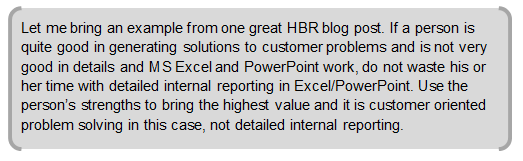
Note: The story is taken from one great HBR post.
How to start?
There are three simple steps to start with:
- Try to identify people’s strengths. MBTI or Belbin roles can help you with this task.
- Ask yourself and your people: “How do I perform?” What environment and actions trigger my strengths?
- What is yours and your people learning mechanism? How do you and your people learn?
Based on these findings you can try to find the best position for you and coach your people to find it as well. Finding the best position for your people should be done with them, of course. It is very important that leader meets people frequently and coaches them(invisibly). Leader should ask questions like: “What kind of tasks do you enjoy the most? What do you love to do? What tasks you don’t like to do?” It helps people to think consciously about their tasks and sets the directions.
Average manager pushes or manipulates his people to change to fit existing uniform boxes and categories, often defined by HR department. But leaders respect personal qualities of each worker. They do not try to change people to fit those uniform boxes, but they rather try to find where these qualities and traits can be most valuable and useful. This is considered not only in team or company context, but in the context of the whole society. Even if it means different company or industry, leader still supports person to achieve that way.
One example of leadership versus traditional management thinking I remember was putting us as Agile and Lean coaches to one of our existing HR boxes. It was hard to explain HR what we do and quite complicated to find existing box that would fit the most.
Also have in mind, that different people are motivated by different factors. Try to uncover these changes during the regular discussions with people as well. Ask but also observe what the factors are in their context. Do not setup uniform goals for all people. Do not think money is the only motivation mechanism. Interesting work, challenging tasks, new stuff to learn, great team, cooperation with customers, solving tricky problems, working with new technologies, different tasks to work on, creative work… all these are the factors that motivates IT people more than money. Of course, this statement is valid only if certain level of salary is achieved and you do not have existence problems (existence problems come from instinct category and thus are stronger than our internal motivation for work).
Next steps
Do you like this approach? If yes, then start with yourself. Identify your strengths, triggers and learning mechanism. Then continue with your team.
Do you do it already? Great! Could you share whether HR and other supporting functions do support this idea? Please, share not only your experience but also proposals how to change it 

Comment section